SEO
SEO Isn’t Dead — It Just Has More Moving Parts
Every algorithm update spawns the same headline. Here’s what actually still works in search, drawn from dozens of conversations with practitioners who do it for a living.
Search out any marketing forum after a Google update and you’ll find the eulogies. “SEO is dead.” It’s the most durable myth in digital marketing — and it’s wrong every time. What’s actually happening is subtler and more interesting: SEO isn’t dying, it’s accumulating. More surfaces, more signals, more ways to be found.
As Erica D’Arcangelo put it on our podcast, “SEO is not dead. There’s just a lot more elements to it than there ever was.” That’s the honest framing. The fundamentals didn’t leave — they got company.
Updates don’t kill you. Incompleteness does.
The best explanation of ranking volatility I’ve heard came from Ernesto Ortiz: “Algorithm updates are just turning the dials on factor importance. If you go down, it’s because you’re incomplete — you optimized for the factors that were currently tuned up, and when they changed the dials, you didn’t have the rest.”
That reframes everything. A site that’s genuinely complete — fast, crawlable, genuinely useful, well-linked, trusted — doesn’t get whipsawed by updates, because it isn’t leaning on a single over-tuned dial. Resilience is just coverage.
The website is still the center of gravity
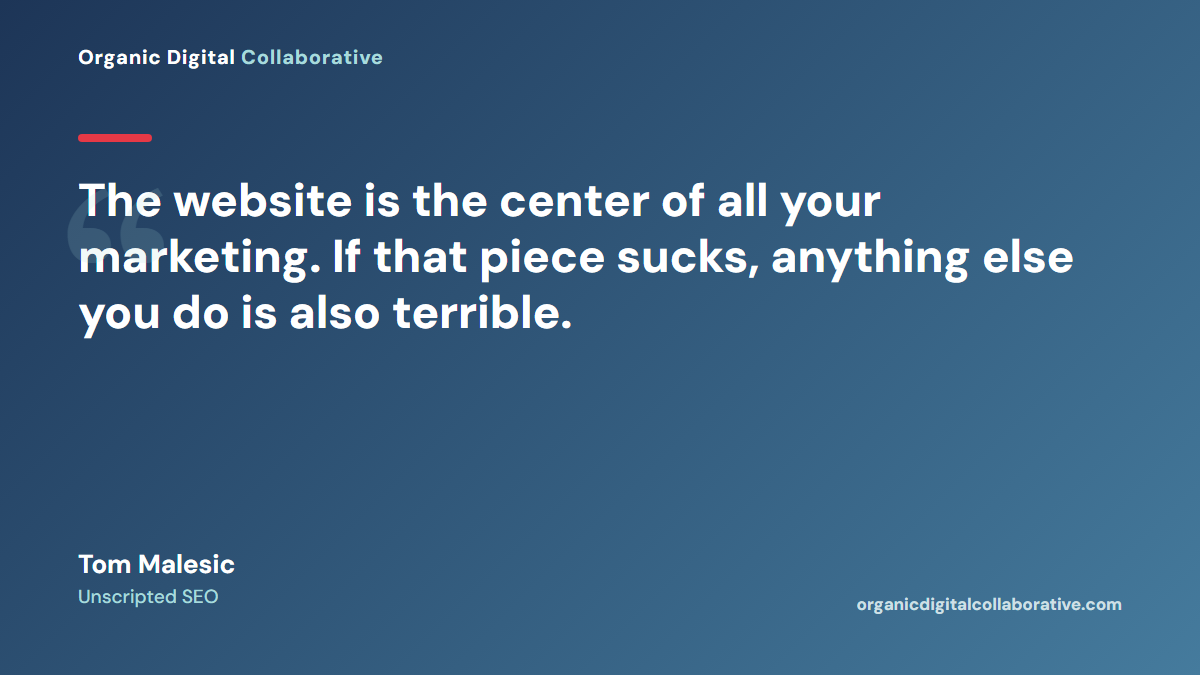
Before you chase any tactic, look at the asset everything points to. Tom Malesic said it bluntly: “The website is the center of all your marketing. If that piece sucks, it doesn’t really matter — anything else you do is also terrible.” Paid, social, email, PR: they all dump traffic onto your site. If the destination doesn’t convert, you’re just renting attention.
Write for the human, structure for the machine
The most common self-inflicted wound we see is copy written for crawlers. Julia Bocchese named it: “I keep seeing clients focusing their copy more on writing for the bots crawling their website rather than the humans that are actually going to be hiring them.” Bradley Benner draws the line cleanly — “the meta title is for the models; the H1 is for the human visitor.” Do both. Never sacrifice the reader to the robot.
It compounds — if you let it
Finally, the trait that separates sites that win: patience with a system. Drew Dorenfest described it as a flywheel — “build things brick by brick. It doesn’t happen overnight, but you see that compounding result. It just works like a flywheel — it gets faster and better and easier.” SEO isn’t dead. It’s just slow at the start and unfair in your favor at the end.
Want a second opinion on your search foundation?
We’ll audit the whole stack — technical, content, authority, and measurement — and show you which dial to turn first.
Book a strategy call →